


When you take a loan, you mostly look at two things — the loan amount and the interest rate.
But banks and lenders often include several hidden charges that silently increase your total repayment.
These small fees don’t seem like much in the beginning, but over time, they can cost you thousands of rupees or dollars.
Let’s break down what these hidden charges are, how they work, and most importantly, how you can avoid them.
What Are Hidden Loan Charges?
Hidden loan charges are extra costs that are not clearly highlighted during the initial loan approval stage.
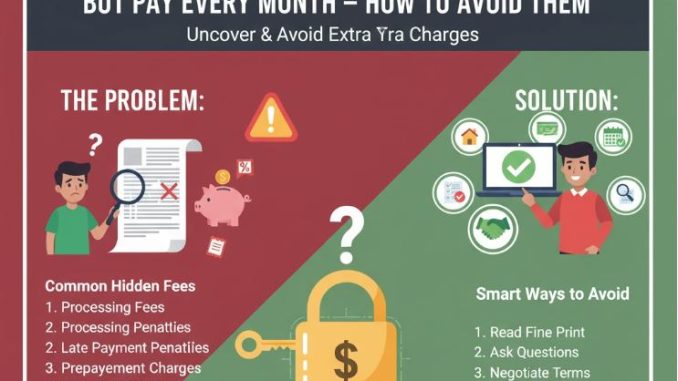
These may include processing fees, documentation charges, late payment penalties, prepayment costs, and insurance add-ons.
In short, they’re the fine-print costs that turn your low-interest loan into an expensive one.
Why Do Lenders Add Hidden Charges?
Banks and financial institutions use service fees to cover operational costs.
However, in a competitive market, they promote their products using “low-interest rate” marketing, and quietly attach charges elsewhere.
For example, a loan may show “10.5% interest,” but with additional fees, the effective rate can rise to 12–13%.
Understanding these fees helps you make smarter financial decisions.
Common Hidden Loan Charges in India and the US
Let’s go through the most common ones you should always check before signing your loan papers.
1. Processing Fee
This is the first charge most lenders take when you apply for a loan.
It’s usually 1% to 3% of the total loan amount in India, and between $50–$300 in the US.
Even if your loan application is rejected or cancelled, this fee is often non-refundable.
Example:
If you take a ₹5,00,000 loan and the bank charges a 2% processing fee, that’s ₹10,000 gone before you even receive the money.
2. Documentation and Verification Fee
These are administrative costs that lenders charge for checking your documents, verifying address, or credit background.
In India, it can range between ₹500–₹2,000; in the US, between $20–$100.
Always ask if these charges are included in your processing fee or billed separately.
3. Prepayment or Foreclosure Fee
Many borrowers think repaying early saves interest — which is true.
But some banks penalize early payment by charging prepayment or foreclosure fees.
This can be 2%–5% of the outstanding balance in India.
In the US, some lenders also charge an “early payoff penalty” on personal or auto loans.
Before signing the loan agreement, check if prepayment is allowed without penalty.
4. Late Payment Penalty
Missing even one EMI can cost you more than you expect.
Apart from late fees (which can be ₹500–₹1,500 per month in India or $20–$40 in the US), lenders also report it to credit bureaus, lowering your credit score.
To avoid this, set up auto-debit or reminders for EMI payments.
Late payments hurt your score and increase your financial stress.
5. Loan Cancellation or Modification Charges
If you decide not to proceed with your loan after approval, some lenders deduct processing and administrative fees.
Similarly, changing your EMI date or tenure may also attract small modification fees.
These small adjustments might seem harmless, but they add up over time.
6. Insurance Add-ons
Many banks offer “loan protection insurance” without clearly explaining it.
The premium is added to your loan amount, increasing your total repayment.
While insurance is useful in some cases, it should be your choice, not a default inclusion.
Always ask your lender to give a breakdown of whether the insurance is optional or mandatory.
7. Conversion Charges
If you have a home or car loan and want to switch from a fixed rate to a floating rate (or vice versa), banks charge a conversion fee.
In India, it’s usually 0.5% to 1% of the outstanding amount.
In the US, mortgage refinancing also involves origination and closing fees, which can be between 1–2% of loan value.
How Hidden Fees Affect the Total Loan Cost
Suppose you take a ₹5 lakh personal loan at 11% interest for 3 years.
On paper, your total interest would be around ₹87,000.
But after adding:
- Processing Fee: ₹10,000
- Documentation Fee: ₹1,000
- Prepayment Fee (if you close early): ₹5,000
Your effective cost becomes ₹1,03,000 — a full 16% increase.
That’s why experts say, never look at only the interest rate — always calculate the “effective annual percentage rate” (APR).
How to Avoid Hidden Charges
- Read the Loan Agreement Carefully
Don’t just sign on the dotted line. Read all fine print, especially “Terms and Conditions” and “Schedule of Charges.” - Ask for a Full Cost Sheet Before Applying
Request a written breakup of every possible fee — processing, prepayment, insurance, and service tax. - Avoid Middlemen or Unverified Apps
Apply directly through official bank websites or registered NBFC apps. Brokers often add extra commission layers. - Use Online EMI Calculators
Before accepting the loan, check the total cost using a reliable EMI calculator that includes processing fees. - Negotiate with the Lender
Many private lenders are flexible if you negotiate politely. Ask them to reduce or waive processing or prepayment fees. - Choose Pre-approved Offers
If your bank already offers you a pre-approved loan, these usually have zero processing charges and faster disbursal.
Country-Specific Insights
In India:
Public sector banks like SBI and Bank of Baroda often charge lower processing fees compared to private ones like HDFC or ICICI.
NBFCs such as Bajaj Finserv or PaySense may offer no CIBIL-check loans but have higher service costs.
In the US:
Fintech lenders like SoFi or Upstart disclose all charges upfront.
However, some traditional banks include “origination fees” and “closing costs” that can add 1–3% to your loan value.
Always compare the Annual Percentage Rate (APR) instead of just the nominal interest rate.
Quick Checklist Before Taking Any Loan
- Ask for a clear loan summary sheet.
- Confirm if there are any prepayment penalties.
- Verify insurance is optional, not mandatory.
- Check total disbursed amount vs total repayment amount.
- Avoid loans that promise “no documents” or “guaranteed approval.”
Final Thoughts
Hidden fees are like silent leaks in your financial bucket.
A loan that looks cheap on paper can become costly once all hidden charges are added.
Whether you’re in India or the US, transparency is key.
The smarter borrower always asks the right questions before signing.
And remember — when it comes to loans, it’s not just about how much you borrow, but how much you actually repay.
Leave a Reply